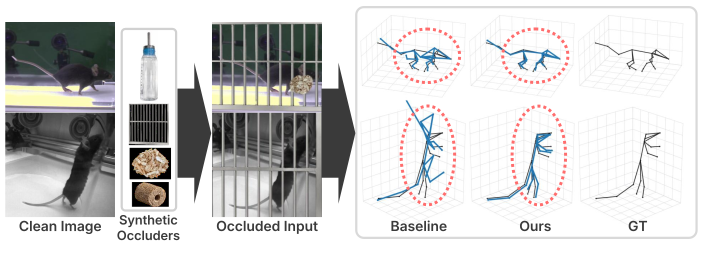
Under severe occlusion, the baseline fails and GenTri still recovers the 3D pose.
Severe synthetic occlusions are applied to the clean frames (left). The baseline produces the structural errors
marked in red, while GenTri reconstructs anatomically plausible poses that remain close to the ground truth (black).
TL;DR
GenTri performs generative triangulation by combining a flow-matching pose prior with
geometric corrections. At each flow step, a Gauss–Newton update guides the pose toward the
2D detections using calibrated camera geometry. A robust Cauchy reprojection loss limits the influence of
unreliable detections.
GenTri achieves comparable accuracy with 3× fewer guidance steps than its first-order variant.
Under synthetic occlusion, it reduces 3D error by 45% on average relative to the corresponding baselines
across three mouse datasets and multiple 2D detectors.
Synthetic cage occlusion on a multi-view treadmill recording.
Under occlusion, the baselines occasionally produce broken poses, while GenTri stays stable. Top: 3D poses from GenTri, Anipose and AdaFuse; bottom: GenTri reprojected onto
the four occluded views.
Shown at 0.25× speed. All methods are temporally smoothed for display only;
the paper's numbers are per-frame.
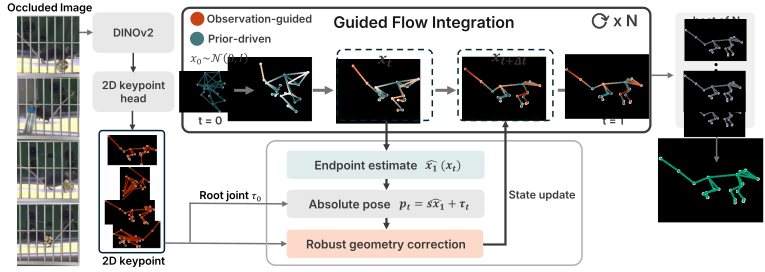
Pipeline
Guided sampling, step by step
Overview of GenTri inference. At each flow step, a frozen flow-matching prior predicts a clean pose.
Robust Gauss–Newton guidance corrects this estimate using multi-view detections and calibrated camera
geometry, while global translation is updated separately. The correction is transferred back to the flow state,
and the hypothesis with the lowest final energy is returned. The animation illustrates this step-by-step process.
Added Occluders
Cage bars and bedding on a second multi-view recording.
Bedding is composited as an additional occluder to mimic a home-cage environment. Even with the objects added, GenTri stays stable
while the baselines occasionally break. Top: 3D poses from GenTri, Anipose and AdaFuse;
bottom: GenTri reprojected onto the four occluded views.
Shown at 0.25× speed. All methods are temporally smoothed for display only;
the paper's numbers are per-frame.
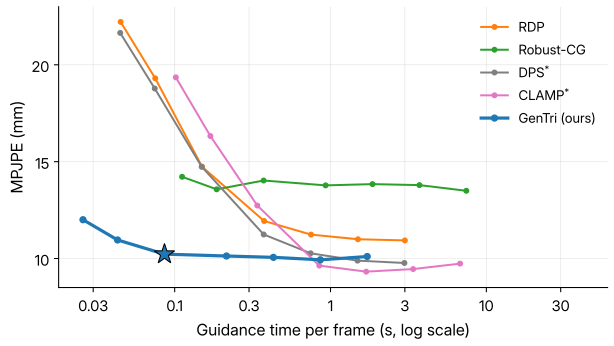
Efficiency
Accurate 3D reconstruction with less guidance time. On occluded mouse data, GenTri reaches low
reconstruction error in about 0.1 seconds of guidance per frame. Competing guidance methods require substantially
more time to match this accuracy, or remain less accurate. ★ marks our default 10-step setting.
Timing excludes 2D detection. DPS* and CLAMP* use our Cauchy reprojection loss.
Without Occlusion
Clean multi-view open-field recording (no synthetic occlusion).
Beyond occlusion, GenTri also improves accuracy on clean inputs in most settings. Top: 3D poses from GenTri, Anipose and AdaFuse;
bottom: GenTri reprojected onto the four views.
All methods are temporally smoothed for display only; the paper's numbers are per-frame.